Tagged “react”

  1. [UPDATED!] Seamless Forms with shadcn/ui and TanStack Form

    ~ cat post <<

    Seamless Forms with shadcn/ui and TanStack Form

    In my post, "Life after Next.js: A New and Sunny Start," I talked about my journey migrating to TanStack Start and the freedom it brought. One of the loose ends I mentioned was the form situation. I'm a big fan of the aesthetics and developer experience of shadcn/ui, but its default form component is built on react-hook-form. As I'm going all-in on the TanStack ecosystem, I naturally wanted to use TanStack Form.

    This presented a classic developer dilemma: do I stick with a component that doesn't quite fit my new stack, or do I build something better? The answer was obvious. I couldn't find a clean, existing solution that married the beauty of shadcn/ui with the power and type-safety of TanStack Form. So, I decided to build it myself.

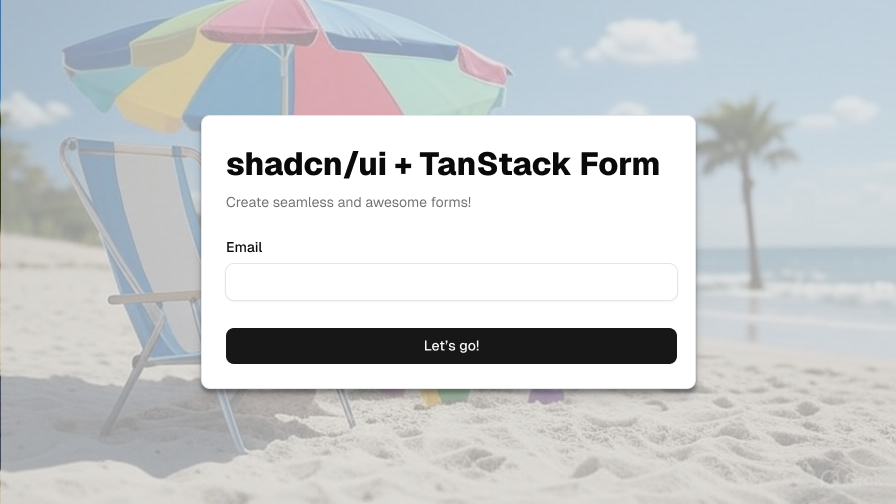
    Today, I'm excited to share the result: a component that seamlessly integrates shadcn/ui with TanStack Form, preserving the core principles of both libraries. It's type-safe, easy to use, and maintains that clean shadcn/ui look and feel.

    You can check out the component's website and find the full source code on the GitHub repository.

    Why Bother?

    TanStack Form offers incredible power with its framework-agnostic, type-safe approach to form state management. shadcn/ui, on the other hand, provides beautiful, accessible, and unopinionated components. The goal was to get the best of both worlds without any compromises. This component acts as the bridge, giving you:

    • Full Type-Safety: Infer types directly from your validation schemas (like Zod, Valibot, etc.).
    • Seamless TanStack Integration: Leverage TanStack Form’s state management and validation logic.
    • Consistent shadcn/ui Styling: Use the form components you already know and love.

  2. Life after Next.js: A New and Sunny Start

    ~ cat post <<

    Life after Next.js: A New and Sunny Start

    A few weeks ago, I posted about my decision to move away from Next.js and the reasons behind that choice. Since projects can't just halt, I couldn't dwell too long on my decision. I had to consider several requirements for my new stack, including:

    • Using React as the frontend library.
    • Support for Server-Side Rendering (SSR).
    • Server-side functions.
    • Middleware support.
    • Enough flexibility to integrate libraries like React-Hook-Form and Axios.
    • A caching mechanism independent of the REST library.

    Initially, I was torn between Remix and TanStack Start. However, Remix lacks middleware support, which would necessitate significant architectural changes and a less ideal way to manage route access. Furthermore, in recent weeks, the Remix project announced a substantial shift in direction for its V3 version. While this new direction appears very promising, it would eventually mean I'd have to rewrite everything again, and that's definitely not something I want.

    TanStack Start, on the other hand, is currently in beta. Yet, it meets all my project's requirements and is built on Vite, making the project far more flexible and independent. Beyond what I've already outlined, the TanStack libraries have an excellent reputation, and this point deserves a small digression:

    Utah probably isn't the first place you'd pick to catch a tan, but if your name is Tanner and you have a good sense of humor, you might just call your TypeScript library stack "TanStack." This textual detour is about him: Tanner Linsley is a programmer renowned for his profound commitment to the open-source community, developer experience, and type safety. TanStack libraries are used by hundreds of thousands of developers and adopted by everyone from startups to Fortune 500 giants. This alone lends significant credibility to TanStack Start, which, at least for me, weighs heavily in my decision for a long-term project.

    Getting back on track, despite its beta status, the development team is now focused on stabilizing the framework rather than building new features, so no breaking changes are expected anymore.

    Still, you might argue that adopting a beta framework for my project carries a high risk, and I agree. However, there are other valid points to consider for my project's current stage. As I've already explained, including in the previous post, going with a no-framework approach would demand a massive effort. Staying with Next.js under Vercel's grip was out of the question. This left me with Remix, which I've already discarded, and TanStack Start, which was my choice. And here's the unexpected upside for me: working with a beta framework also has its advantages.

    As soon as I ran into the first development hurdles, I was directed to the TanStack Discord server. There, numerous developers exchange information and answer questions about the libraries. The project's own developers actively respond to queries, report bugs, ask for new issues to be opened, etc. Even Jack Herrington is there, participating actively!

~ <<

See all tags .