Project Loom: Java's Virtual Threads – From Nightmares to Modern Concurrency Bliss
~ cat "Project Loom: Java's Virtual"~ cat post <<
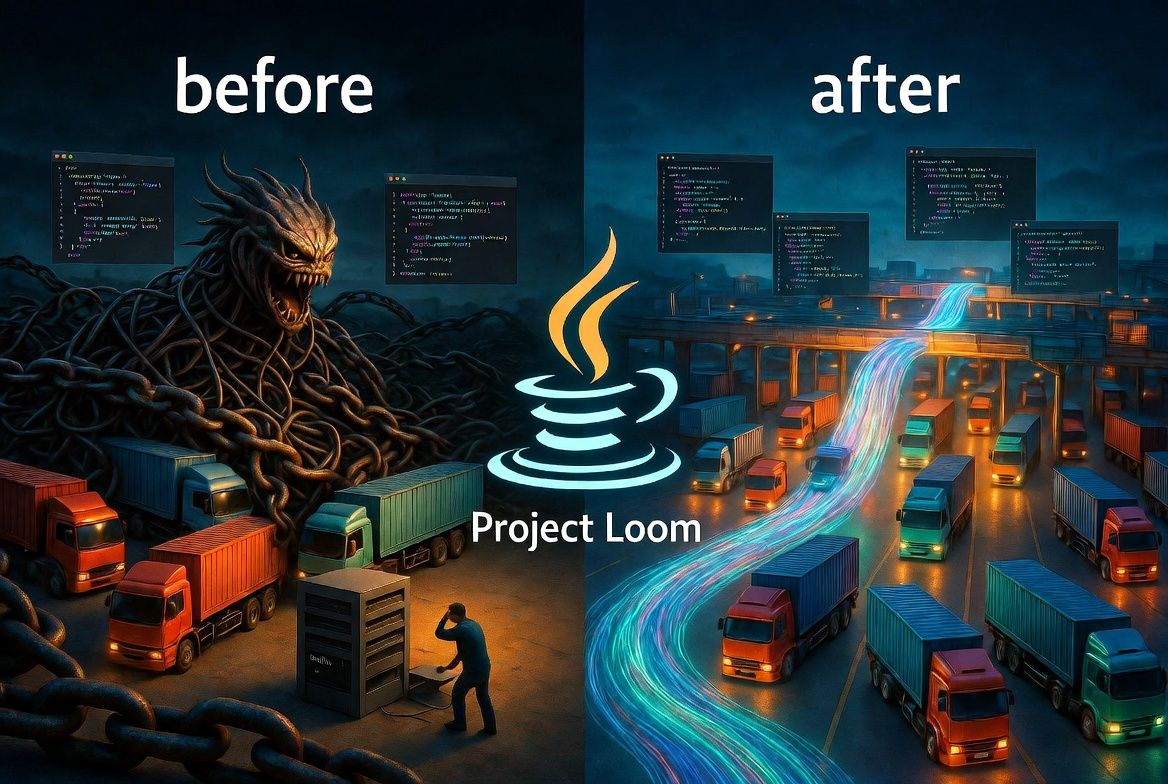
In 2006, I worked on a large logistics system for transporting wood for pulp production. One of the most critical modules managed the entry and exit of trucks from a storage yard. We implemented it using Threads in Delphi 7. The debugging process was an absolute nightmare.
Hundreds of trucks arriving and leaving, each one triggering database checks, sensor readings, queue management, and synchronization logic. Every thread was a heavyweight OS thread. Memory usage skyrocketed, context switching killed performance, and when something went wrong (which happened constantly), the debugger would freeze or show you a stack trace that made zero sense because the threads were all fighting for the same resources.
Sound familiar?
That exact pain — the same pain Java developers have felt for 30 years with regular Thread objects and ExecutorService backed by platform threads — is what Project Loom was created to eliminate.
Today, with Java 21+ (and fully mature in 2026), Virtual Threads are production-ready and change the game completely.
Let’s demystify Project Loom and see, with real Java code, why Virtual Threads are not just “better threads” — they are a completely different beast.
The Problem with Traditional (Platform) Threads
Since Java 1.0, every new Thread() or thread from a ThreadPoolExecutor is a platform thread:
- It maps one-to-one to an OS thread.
- It consumes ~1 MB of stack space (configurable, but rarely less).
- Creating thousands of them is expensive and risky.
- Blocking operations (I/O,
sleep(), database calls, HTTP requests) block the entire OS thread. - Context switching is handled by the operating system (expensive).
In the 2006 Delphi system, we could barely handle a few hundred concurrent trucks before the server started thrashing. The same limitation existed in Java until Project Loom.


